
How to Choose a Home Fragrance Manufacturer for Your Private Label Brand
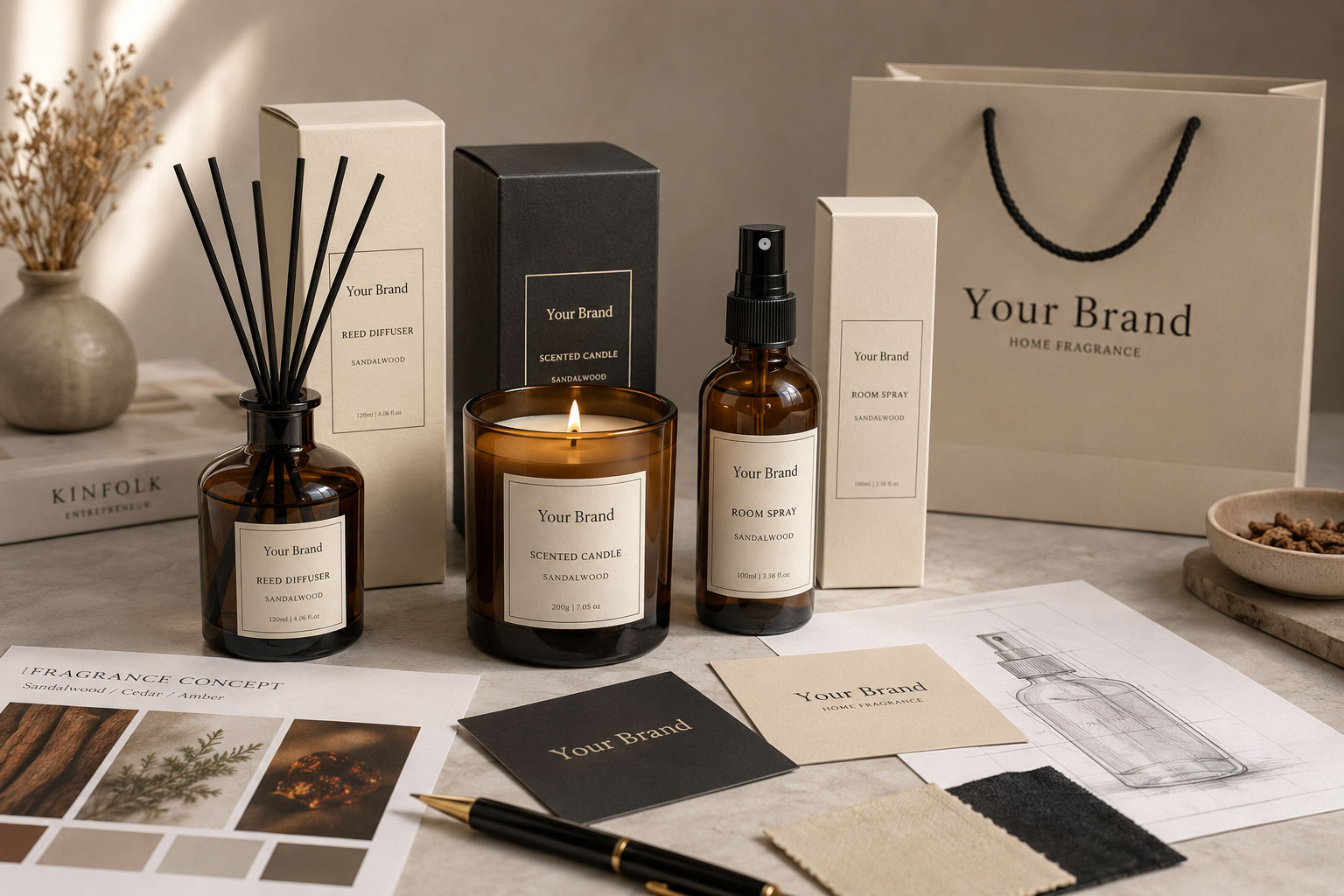
Choosing the right home fragrance manufacturer is one of the most important decisions when developing a private label fragrance collection.
A supplier is not simply responsible for filling bottles or producing candles. The right manufacturing partner can affect your fragrance quality, packaging consistency, product positioning, launch schedule and ability to scale after your first order.
For independent fragrance brands, retailers, Amazon sellers and lifestyle companies, the challenge is often not finding a supplier. There are many manufacturers offering reed diffusers, candles and room sprays.
The real challenge is finding a manufacturer that fits your product strategy and business model.
Before requesting quotations from multiple suppliers, here are the key areas you should evaluate.
1. Start with the Product Range You Want to Build
Your first question should not simply be:
“Can you manufacture reed diffusers?”
Instead, consider what your brand may need over the next one to three years.
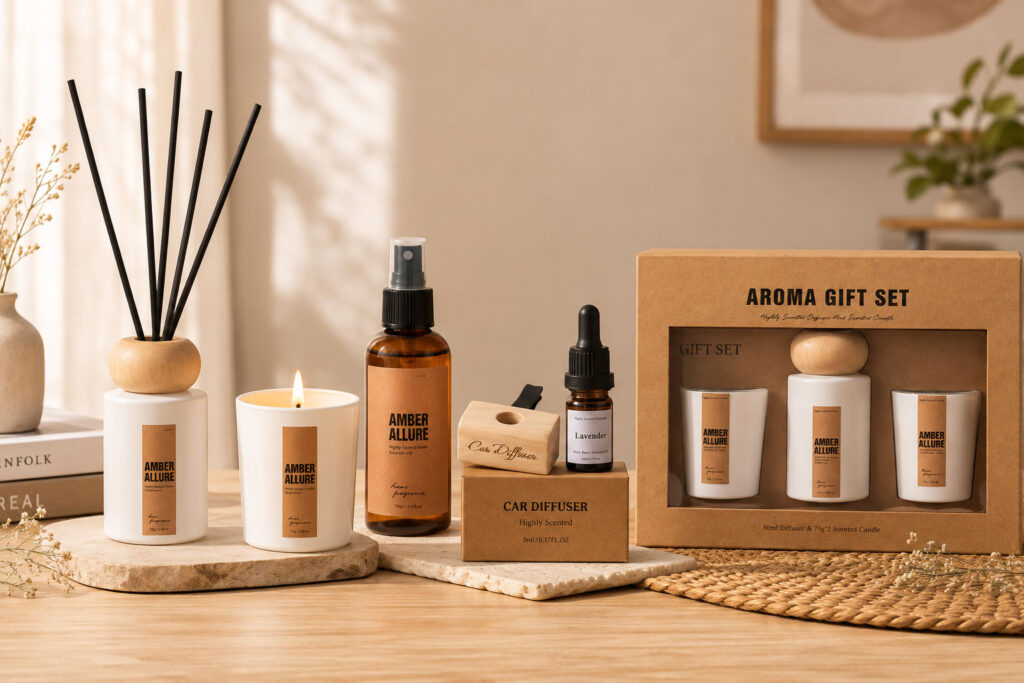
A home fragrance collection may start with one product but gradually expand into:
- Reed diffusers
- Scented candles
- Room sprays
- Fragrance refills
- Car diffusers
- Home fragrance gift sets
- Seasonal fragrance collections
Working with a manufacturer that supports several related categories can make future product development easier.
For example, a brand launching a reed diffuser may later want a matching candle and room spray using the same fragrance direction and visual identity.
Using one experienced home fragrance supplier for multiple categories can help create a more coordinated collection while reducing the need to manage several unrelated factories.
That does not mean you should choose the supplier with the longest product catalogue. What matters is whether the manufacturer has real experience with the categories that are relevant to your brand.
2. Evaluate Private Label and Customization Capabilities
There is an important difference between buying an existing product and developing a private label collection.
Some suppliers mainly sell ready-made products with limited customization. Others can support deeper private label development.
Before choosing a private label home fragrance manufacturer, confirm what can actually be customized.
Fragrance
Can you select from an existing fragrance library? Can the manufacturer work with a fragrance direction or reference sample? Can different scent options be developed for one collection?
Vessel
Can you choose different diffuser bottles, candle jars or spray bottles? Are custom colours, finishes or decorative processes available?
Label
Can the supplier apply your brand artwork, ingredient information, warnings and other required label content?
Packaging
Can the product be supplied with a custom printed carton, rigid gift box, sleeve, insert or other retail packaging?
Product Combination
Can different products be combined into a coordinated gift set?
The more customized the project becomes, the more important sampling and approval become.
A good private label process should allow both sides to confirm important details before mass production rather than trying to solve everything after an order has been placed.
3. Ask How Fragrance Development Works
Fragrance is one of the most subjective parts of home fragrance development.
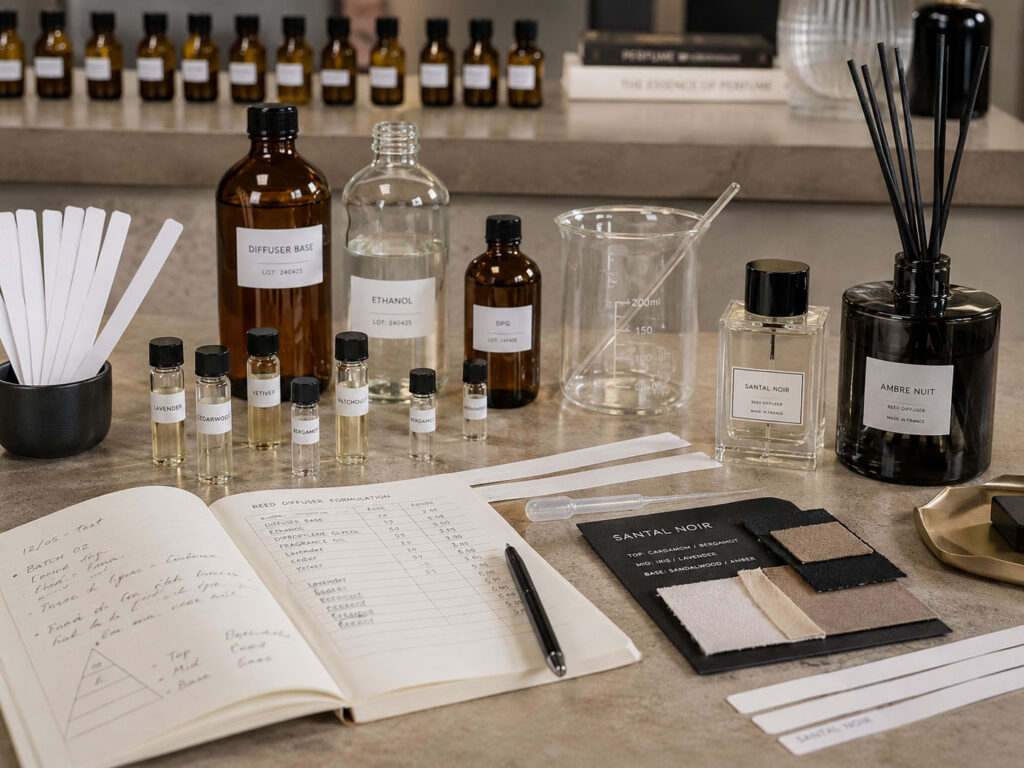
Descriptions such as “luxury”, “fresh”, “woody” or “hotel scent” can mean very different things to different people.
A professional development process should therefore move from a broad fragrance idea toward physical samples.
Fresh & Clean
Citrus, linen, marine or green notes.
Floral
Rose, jasmine, peony or white floral profiles.
Warm & Sophisticated
Amber, vanilla, sandalwood or musk.
Botanical & Natural
Herbal, tea, woody or green fragrance directions.
The manufacturer can then recommend suitable fragrance options for evaluation.
For a private label project, fragrance selection should normally be confirmed through samples before production.
Do not rely only on fragrance names.
“White Tea”, “Santal”, “Ocean Breeze” or “Luxury Hotel” may sound attractive on a product page, but the actual scent experience is what your customers will eventually evaluate.
4. Check Whether Packaging Matches Your Sales Channel
Packaging requirements can change significantly depending on where the product will be sold.
A boutique fragrance brand may prioritize visual presentation and unboxing experience.
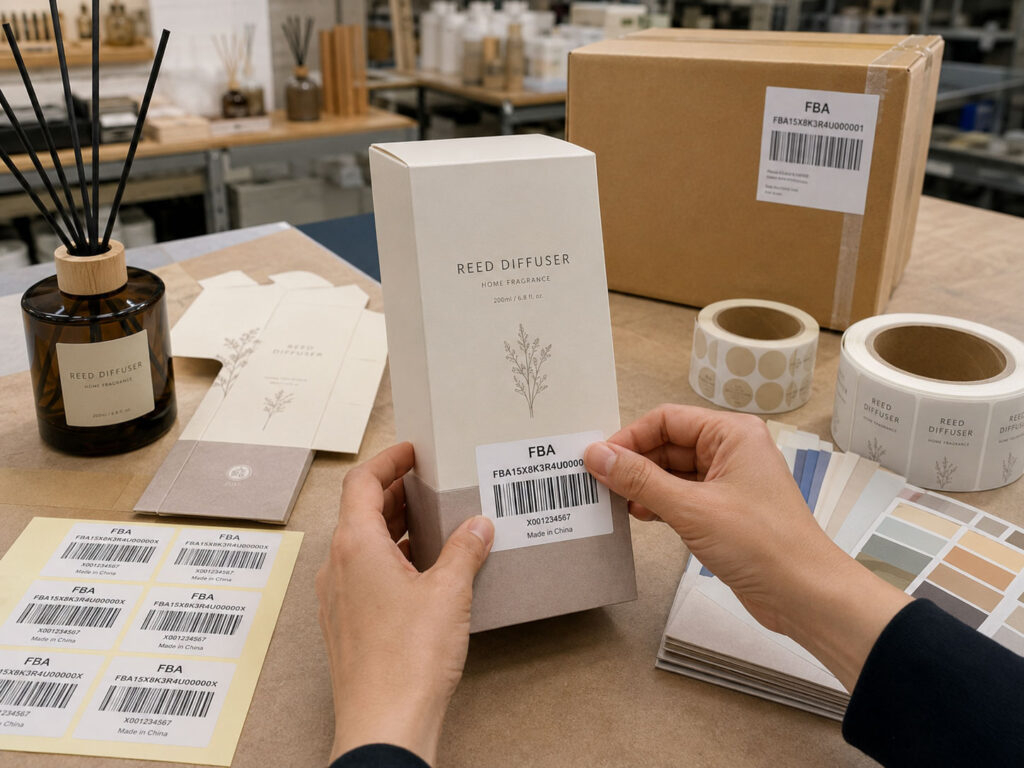
A retail buyer may pay more attention to shelf presentation, barcode areas, warnings and carton efficiency.
An Amazon seller may need to consider unit protection, labelling requirements and fulfilment conditions.
A gifting brand may require inserts, ribbons, sleeves or multi-product packaging.
Therefore, when discussing your project with a home fragrance manufacturer, explain your sales channel early.
Useful information to share includes:
- Target market
- Online or offline sales channel
- Product category
- Estimated quantity
- Target retail price
- Desired packaging style
- Launch date
- Brand positioning
This gives the supplier more context when recommending products and packaging.
A beautiful package is not automatically the right package. The best packaging balances brand presentation, product protection, purchasing cost and distribution requirements.
5. Understand MOQ Before Comparing Prices
MOQ is often one of the first questions buyers ask.
However, MOQ should not be evaluated separately from customization.
A standard bottle with an existing fragrance and simple label may have very different production requirements from a custom-colour vessel with bespoke packaging and a newly developed fragrance.
When requesting a quotation, clarify exactly what the MOQ refers to:
- MOQ per product
- MOQ per fragrance
- MOQ per colour
- MOQ per packaging design
- MOQ per custom component
This becomes especially important when developing multiple SKUs.
Imagine you want three reed diffuser scents. A quotation based on one fragrance may look attractive, but the total project requirement could change when you divide the order across three fragrances.
For new brands, flexibility during product testing can sometimes be more valuable than achieving the lowest possible unit cost immediately.
Once a product proves successful, order volumes and purchasing efficiency can be improved in later production runs.
6. Do Not Compare Suppliers on Unit Price Alone
Home fragrance quotations can look deceptively simple.
Two suppliers may both quote a 100 ml reed diffuser, but the products may differ in:
- Bottle design
- Fragrance formula
- Fragrance concentration
- Diffuser base
- Reeds
- Decorative process
- Label material
- Inner packaging
- Carton specification
- Customization level
- Quality control requirements
The same applies to scented candles.
Jar material, wax system, wick selection, fragrance, filling weight, surface finish and packaging can all influence the final product.
Before deciding that one manufacturer is “cheaper”, make sure you are comparing equivalent specifications.
For private label buyers, the more useful question is often:
“What product specification can we build within the target cost?”
This allows the manufacturer to recommend a realistic combination of product, packaging and customization based on your intended market.
7. Review Sampling Before Mass Production
Samples are not just for smelling the fragrance. They are an important part of product development.
Depending on the product, you may need to review:
- Fragrance
- Bottle or jar
- Product colour
- Label size and position
- Logo appearance
- Packaging artwork
- Box structure
- Gift set arrangement
- Overall presentation
Sampling is especially important when several components come together.
A label that looks attractive on a computer screen may appear too small on the actual bottle. A carton colour may look different after printing. A gift box may need adjustments after physical products are placed inside.

It is usually easier to solve these issues during sampling than during mass production.
8. Ask About Quality Control
Home fragrance products combine liquids, fragrance materials, glassware, packaging and decorative components.
This means quality control should cover more than the finished appearance.
- Incoming components
- Bottle and jar appearance
- Filling
- Product weight or volume
- Label position
- Packaging assembly
- Finished product inspection
For candles, product development may also require attention to the relationship between the wax, fragrance, vessel and wick.
For reed diffusers, the fragrance formula, diffuser base and reeds all contribute to the final product experience.
Ask the manufacturer how quality is controlled during production rather than simply asking whether they “have QC”.
9. Discuss Documentation and Destination Requirements Early
Home fragrance products may have different documentation, labelling, transportation and marketplace requirements depending on the product formula and destination market.
These requirements should be discussed before production.
Tell your supplier where you plan to sell the products, for example:
- United States
- United Kingdom
- European Union
- Canada
- Middle East
- Australia
You should also explain whether the products will be sold through your own website, retail stores, marketplaces or distributors.
Documentation requirements can vary by product and destination, so avoid assuming that one document automatically covers every market.
A responsible manufacturer should be willing to discuss available product information and documentation while confirming project-specific requirements before production or shipment.
10. Consider What Happens After the First Order
Many buyers focus entirely on launching their first product.
But the best supplier relationships are usually built around what happens next.
- Can this manufacturer support additional scents?
- Can we add a candle to our diffuser collection?
- Can we create seasonal packaging?
- Can we reorder successful SKUs?
- Can we develop gift sets?
- Can the supplier maintain a consistent visual direction across the range?
This is particularly important for independent brands.
Your first purchase may be relatively small, but if the product performs well, your supply chain needs to support repeat orders and new product development.
Choosing a manufacturer only for the first order can create unnecessary supplier changes later.
Manufacturer or Trading Company: Which Is Better?
Buyers often assume that working directly with a factory is always the best option.
In reality, the right choice depends on the project.
A focused manufacturer can be valuable when production control and category specialization are important.
A sourcing or trading company may provide advantages when a project involves many unrelated product categories from different factories.
For a home fragrance brand, what matters most is transparency.
You should understand who is producing the products, who is responsible for development and quality control, and how communication is handled throughout the project.
The goal is not simply to find the shortest supply chain. It is to find a supply chain you can understand and manage.
Questions to Ask a Home Fragrance Manufacturer
- Which home fragrance products do you manufacture?
- What private label options are available?
- Can I customize fragrance, colour, label and packaging?
- What is the MOQ per product and per fragrance?
- How does your sampling process work?
- What information do you need to prepare a quotation?
- What quality checks are performed during production?
- What packaging options are available for my sales channel?
- What product documentation can be provided?
- Can you support repeat orders and future product extensions?
Clear answers to these questions can tell you much more than a product catalogue alone.
Choosing a Manufacturing Partner for Long-Term Growth
Finding a home fragrance manufacturer should not be treated simply as a search for the lowest quotation.
You are choosing a partner that may influence your fragrance development, product quality, packaging, launch schedule and future collection.
For many private label brands, a good starting point is to prepare a simple project brief containing:
- Target market
- Sales channel
- Product category
- Preferred style
- Fragrance direction
- Estimated quantity
- Target price range
- Packaging requirements
- Target launch date
The more clearly you explain the commercial goal behind the product, the easier it becomes for a manufacturer to recommend a suitable solution.
Looking for a Private Label Home Fragrance Manufacturer?
Suzhou Runfan Home Decoration Co., Ltd. works with home fragrance businesses developing products such as
reed diffusers,
scented candles,
room sprays,
car fragrance and gift sets.
Whether you are building your first private label fragrance collection or expanding an existing range, you can send us your product direction, quantity, target market and packaging requirements.
We can review your project and discuss suitable product and customization options based on your requirements.
FAQ About Choosing a Home Fragrance Manufacturer
What products can a home fragrance manufacturer produce?
Depending on the manufacturer, product categories may include reed diffusers, scented candles, room sprays, fragrance refills, car diffusers and home fragrance gift sets.
Can I create my own private label fragrance?
Many private label manufacturers can support fragrance selection or development together with custom labels, packaging, vessels and other branding options. Available customization depends on the individual project and production requirements.
What should I send a manufacturer before requesting a quotation?
It is useful to provide your target market, sales channel, product type, estimated quantity, fragrance direction, packaging requirements, target price range and expected launch date.
Should I order samples before mass production?
Sampling is recommended for private label projects because it allows you to evaluate fragrance, product appearance, labels, packaging and other important details before mass production.
Is the lowest-priced home fragrance manufacturer always the best choice?
Not necessarily. Buyers should compare product specifications, customization options, packaging, quality control, sampling support and long-term supply capabilities rather than evaluating unit price alone.